

Part 1 - From Solitude to Synergy
‘How would you like to be involved in an exciting collaborative project where you don’t get paid and have limited creative control?’ This was my opening pitch as I tried to entice eight fellow mosaic artists to create a unique work of art. It was a cheeky attempt to attract people with the right attitude—those for whom collaboration would be fun and who had an open mind. This would be essential, and it quickly became a test of my vision and leadership capabilities.
Creating mosaics, for me, has always been a solitary pursuit. When working on a commission, of course there is collaboration between artist and client, but for the most part, the actual creation—God willing—is a solo effort. This is the appeal, as I’m sure it is for many readers. Once I’m in the studio, the radio goes on, the phone goes off, and I’m alone with the work. The process of letting your subconscious spill onto canvas—or in my case, tile board—is greatly hindered, I’ve found, by taking suggestions and welcoming feedback.
That being said, when allowing myself to reflect, I believe the essence of all art is rooted in relationships. If an artist is working truly, they are never really doing it just for, or by, themselves. I didn’t fully realise this until I stepped out of the studio.
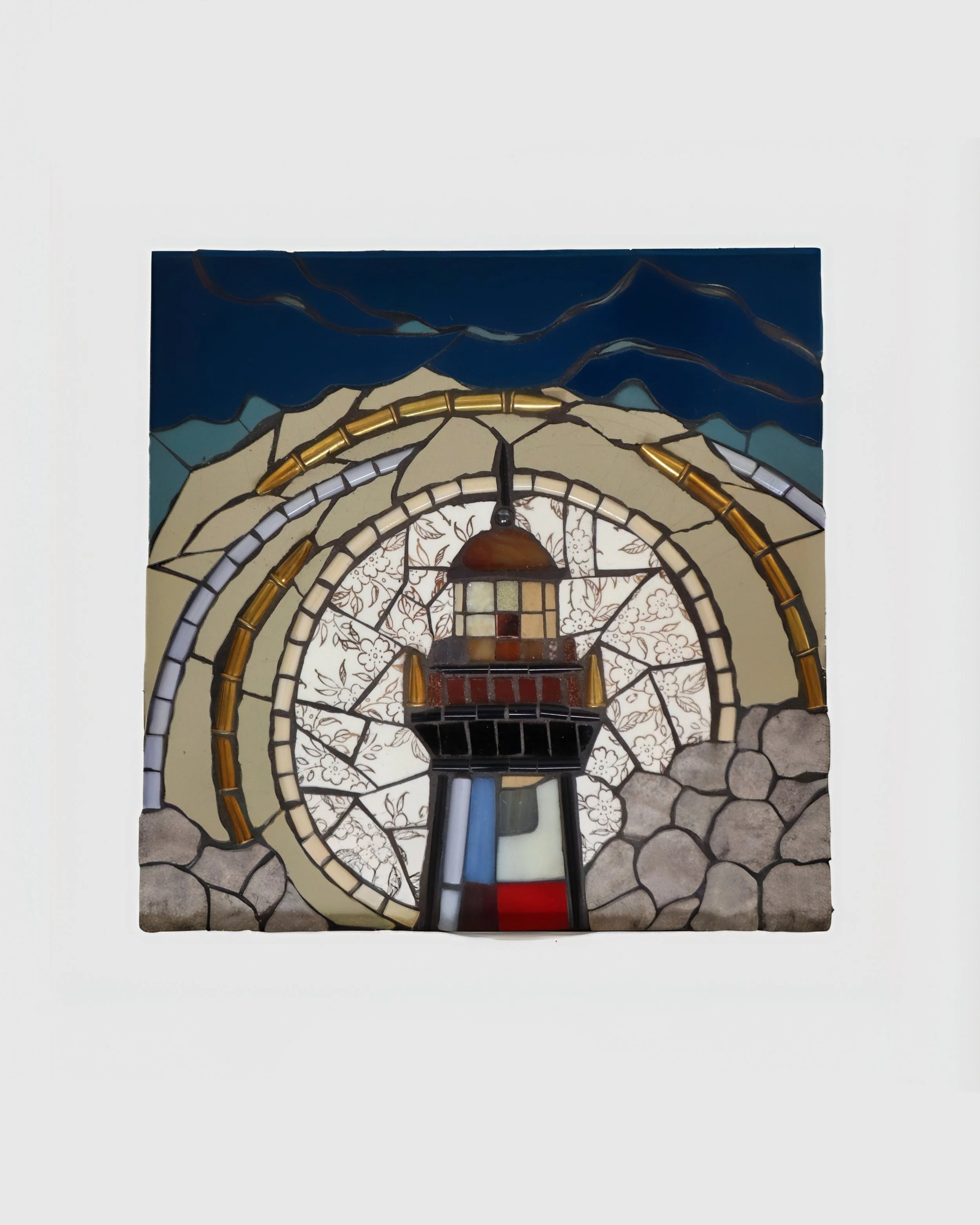
The first board to return by Alison Turner @alisonturnermosaics
I was invited to share my story with the Alveston Mosaic Group, based in a small village just outside of Bristol. I’d recently suffered a career-shattering injury and found solace in finally having the time to work on my art. It’d been twelve years since I’d exhibited in London, New York, and California, so it was both a surprise and an honour to discuss my work and techniques with the collective—a small group of amateur mosaicists who meet fortnightly to work on projects, sometimes collaboratively but mostly individually.
They not only shared a workspace—a large, light-filled, modern room within a local church—but they also shared tools, and more importantly, they shared ideas. It was wonderful to see a variety of styles being explored, with plenty of note-sharing and some fascinating crossovers.
I left the meeting with a renewed sense of happiness—not only at how my mosaics still resonated with people, but at how the artform itself can unite and bring comfort to those who seek connection through creativity and specifically mosaics. It reinforced an idea that had been forming in my mind: that art is collaboration. Whether between the observer and the art itself, or on a more meta level within the artist—the connection between subconscious and conscious.
It was time to re-evaluate how I approached my projects. As I left and bungee-tied my work to various tether points in the back of my van, I reflected on the many hours I’d put into each piece. Each one created in solitude. I’d wanted to create a piece dedicated to mosaics and its practitioners for a while now, but instead of working alone on this large piece, which would realistically take six week, what if I engaged eight fellow mosaic artists to join me in a pure expression and celebration of collaboration?
By the time I arrived home in Bristol—just a thirty-minute drive—I’d devised a plan. I would create an image (of what, I wasn’t yet sure), place a grid over it, and divide it into equal squares. I’d cut the image into individual sections and send them out for artists to use as templates for their own contributions, each expressed in their individual style. Once returned, I’d knit the pieces together, creating a mosaic within a mosaic, celebrating the diversity of our shared artform through a range of techniques and materials.
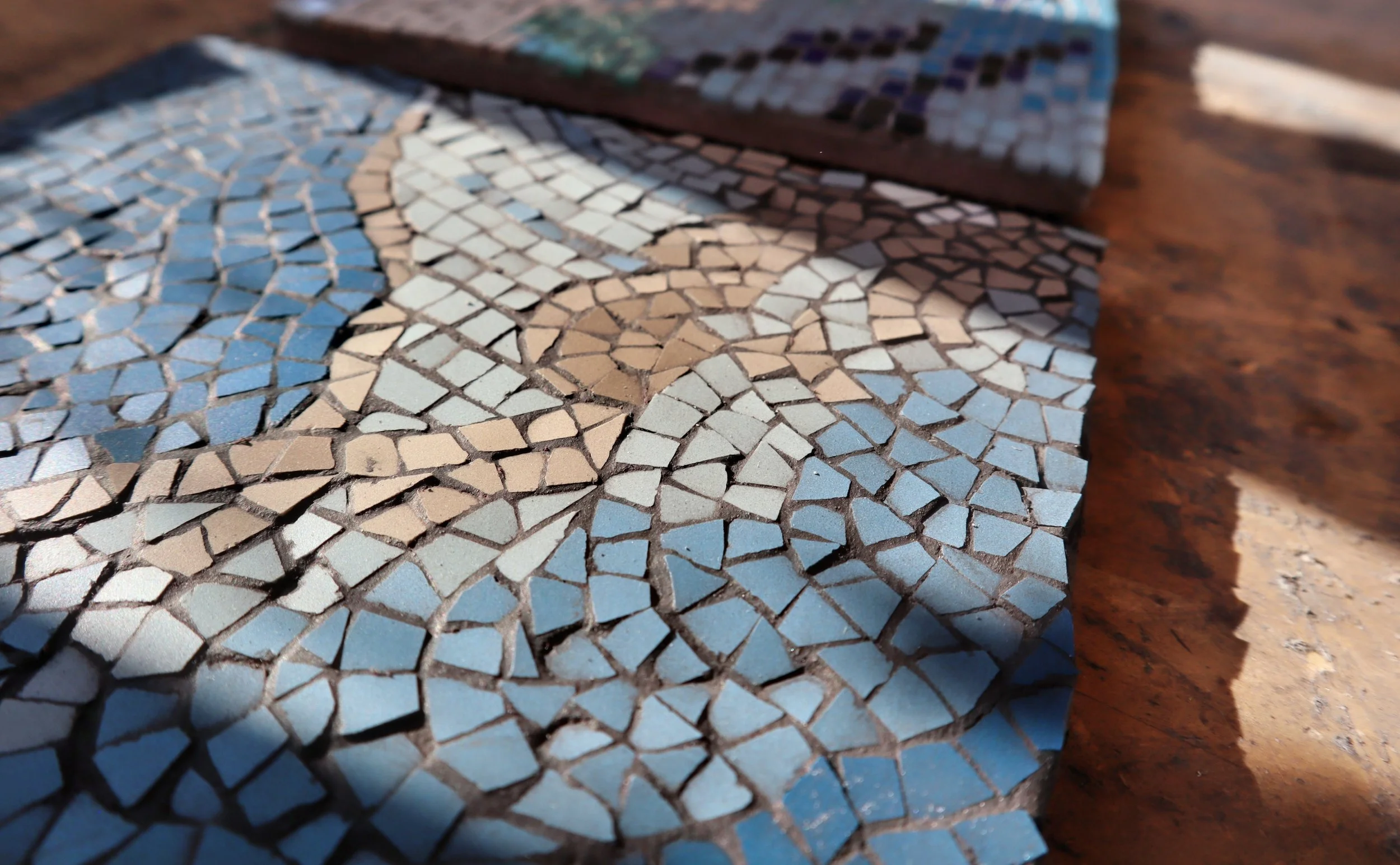
The image started to come together
I knew I’d need to set some ground rules. Artists would be asked to stay as close as possible to the original colour scheme, allowing the overall image to flow when reassembled. The material and grouting choice would be down to them. I decided to send each artist a backing board—6mm Jackoboard—for its waterproof qualities, as the final location of the piece was still undecided.
I settled on a nautical-themed image (the reasons behind this choice will be revealed in the next edition, along with the finished piece). As with all my work, I began in a sketchbook where I could play with colours and composition. I find the freedom of pencil on paper liberating—especially in contrast to 6mm ceramic tile.
I once read that early creative teams at Disney worked in dedicated “creative spaces”—brightly coloured rooms with soft, rounded walls and bean bags for chairs. These were places where real world constraints didn’t exist, allowing for unrestricted brainstorming sessions. Once ideas were finalised, they were passed to a conventional office room—accountants and lawyers in suits—who scrutinised everything for legality and profit. Collaboration.
In principle, that’s not far from how I work: I sketch freely, then ask myself how to turn that into something tangible using block-colour ceramic tiles. How do I make it durable, beautiful, and ideally waterproof? A tug-of-war commences in my mind and eventually a resolution is made.
There was no budget for this project, and no payment. Everyone had to cover their own materials and postage. I was upfront about this, and made it clear that if the final piece were ever sold, proceeds would be divided equally.
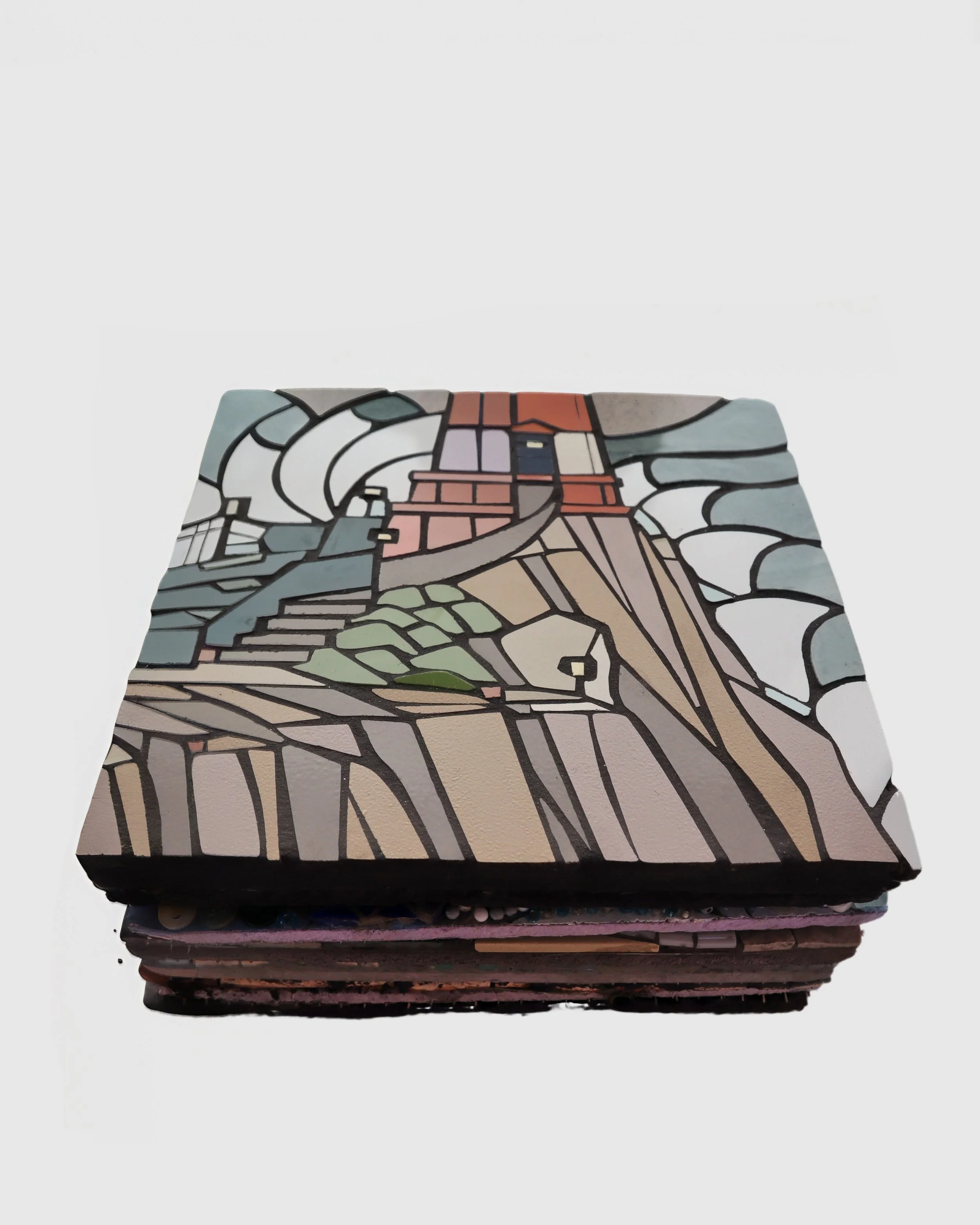
Individual boards stacked
Soon, finished squares began arriving through my letterbox. It was fascinating to see how each artist responded to their section—without knowing what the full image looked like or how their piece fit into the whole. The only two squares featuring a building were the first to return. Maybe that says something about how the skill of abstract landscape work is often underappreciated in mosaics. That’s not to say buildings are easy—far from it. I chose two artists who I knew would interpret those forms beautifully and essentially tie the entire image together. That’s what’s so special about this piece: remove just one square, and rip—the whole thing falls apart. What amazed me most was how unmistakably personal each square became. Every one of them reflects the artist’s style and material choices. This is exactly what the project was meant to celebrate: how a single term like ‘mosaics’ can inspire such wildly individual expression. Like a firework powdering the sky—each fleck unique, even though they all begin in the same little tube.
In the next article, I’ll explain how I made design decisions, how I allocated the squares, and what I’ve learned about managing a creative team versus a typical business group. There will also be images of the grand unveiling—and a glimpse into what’s next for this piece and for collaborative mosaic making.
In the meantime, please check out my wonderful collaborators on Instagram:
Dionne Ible
