

Why I Don't Use Mosaic Nippers
Imagine you’re new to mosaics. You’ve admired for a long time and now you fancy giving it a go. First, you need some tools. If you asked ten mosaicists which nippers they recommend, you'd probably receive ten different answers.
Some will tell you to buy tungsten wheels. Others will insist on spring-return handles or comfort grips. They're all sensible recommendations.
I ignore them all.
I use Knipex Concreters' Nippers.
They're designed for cutting wire and reinforcing steel before concrete is poured, not for making mosaics. Yet after trying almost every tool available to mosaicists, they're the only pair I reach for.
The obvious question is: why? To answer that, it's worth taking a step backwards.
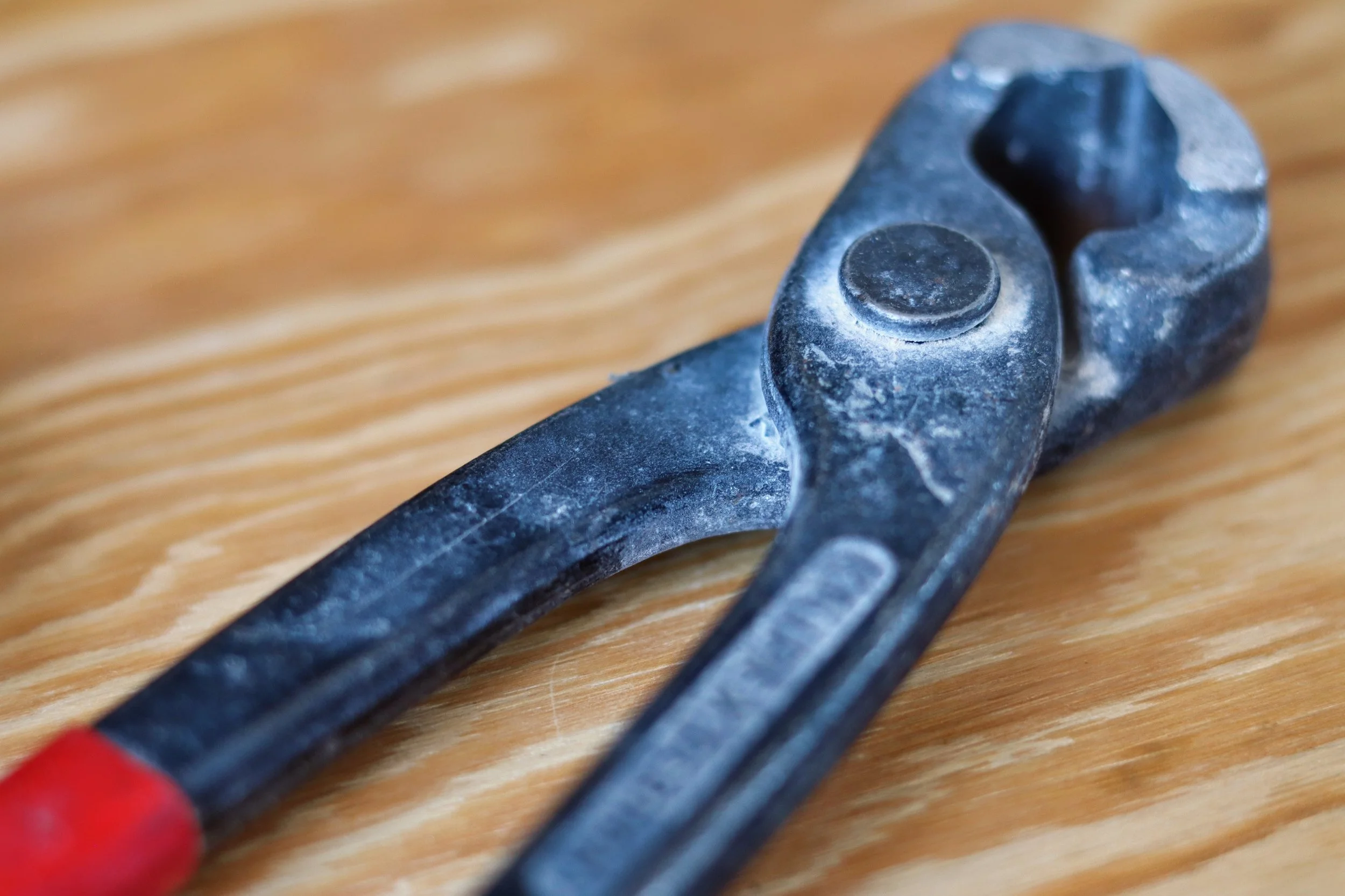
My Knipex Concreters’ Nippers
Traditionally, material used by mosaicists would come in slabs or long strips, therefore they’d use a hammer and hardie to break the material into manageable pieces. A hardie is a forged bulbous shaped chisel which is hammered into hardwood or a worktop with the sharp end pointing upwards. This remains stationary. You slide your material to where you want to break it. The underside of the tile is in contact with the sharp end of the hardie and with your hammer, usually a flat headed one and sometimes wrapped in fabric to protect your tile, you hit the tile so that it fractures over the hardie rather than be smashed directly from your hammer. To this day, this is a good technique for quickly cutting tesserae in a uniform fashion, if say, you needed lots of tile all similar size.
Nowadays, the raw material used by mosaisicts come in easy to handle sizes and some even come pre-cut into universal squares or rectangles. Doing away with the hammer and hardie all-together. I haven’t got a hammer and hardie set-up, although I would like to install one. Possibly for romantic reasons. If we don’t practice the old-ways, they die out. As a craftsman or artist; to ignore a technique which has lasted, literally, thousands of years, would be reckless.
So how do you cut intricate shapes from pre-formed material. You could still use a hammer and hardie in the same way a writer could still use fountain pen and ink pot. Whilst still being manual we’ve developed a portable, lightweight solution; Nippers. Sometimes called snips, tile cutters or mosaic wheels.
If you follow the general advice on choosing mosaic nippers – you buy; something with a high strength blade or wheel (often tungsten), comfort grip, safety clasp and a spring return mechanism. This might sound high-tech for such an ancient artform. All very commercial, all very safe. Which is exactly why I don’t use mosaic nippers at all and use Concreters’ Nippers.
That being said, safety is something to consider. The end of your mosaic nippers, understandably, need to be sharp and you could very easily damage your digits by squeezing at the wrong time. Manufacturers combat this by leaving a very small gap between the teeth when fully closed. For safety this is rational and very wise. Although for cutting intricate shapes this can sometimes be a hindrance. Your nippers simply don’t meet exactly where you may want the cut to appear. My Concreters’ Nippers do meet. This means when I squeeze to make a cut, the 2 teeth cut through the tile and meet together, flush. Much like the 2 doors closing when getting inside a lift.
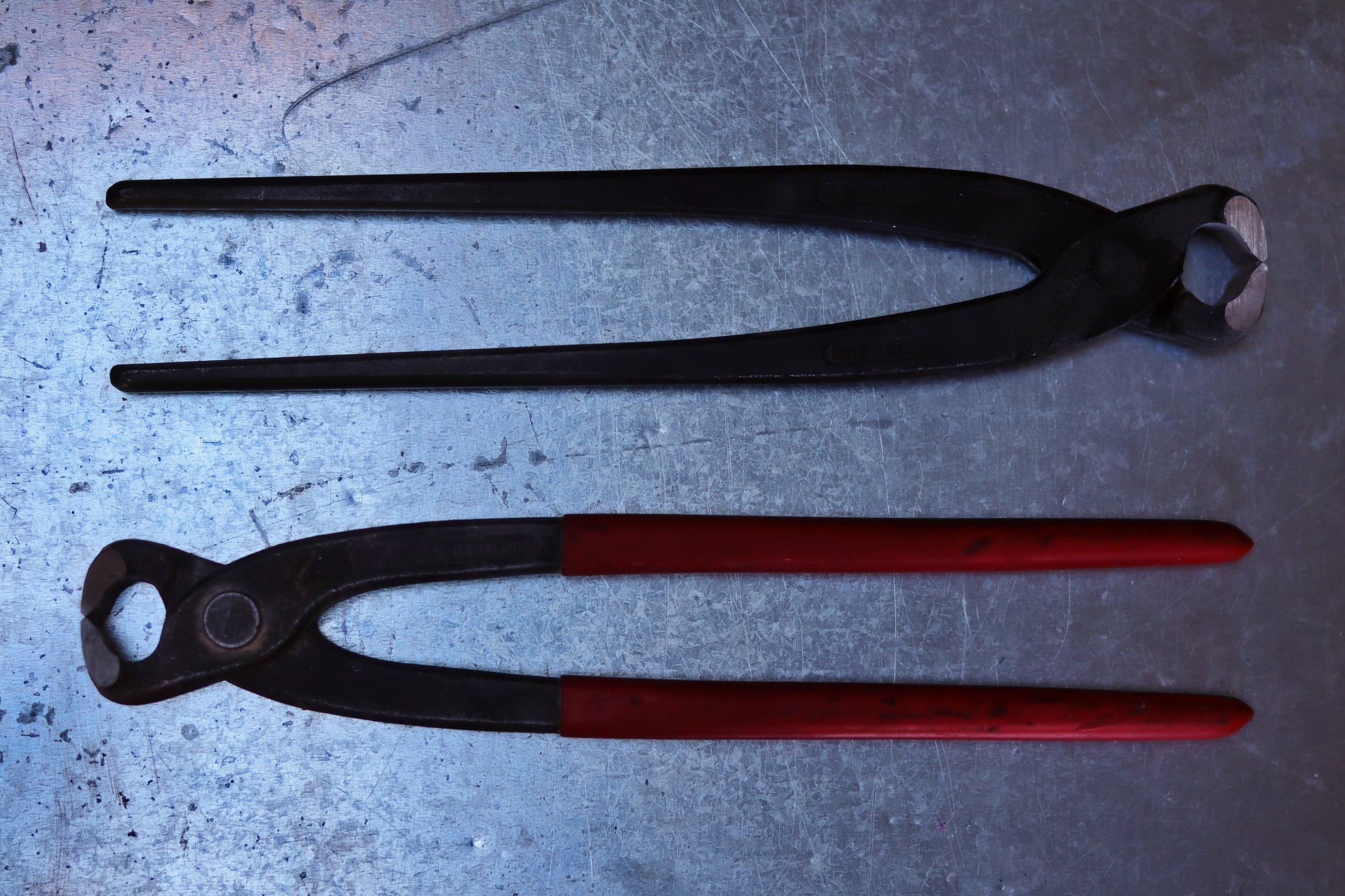
Top: Steel Only. Bottom: Plastic Sleeves
Another rational and wise design feature on your nippers is the soft comfort grip. Your recommended nippers will have a chunky, non-slip plastic handle. Great for long days spent cutting tile. Not-so-great if you really want to feel the cut. There’s an unexplainable tactile sensation when making cut after cut. Here’s my best attempt to explain the unexplainable – imagine you work on a check-out with a long black conveyor belt and your job is to scan every item placed on that belt. After hours of scanning thousands of items you begin to know, by intuition where the barcodes are going to be printed on the packaging. Without thinking, you pick up a cereal box and you tilt it to the scanner. Back to your nippers. There’s a muscle memory achieved when you squeeze your nippers, at first pinching the tile so it doesn’t slip, and just before it snaps you release your grip, only slightly, unnoticeable to the naked eye, to achieve the desired cut. It’s purely tactile. No book can tell you exactly what to do but after thousands of cuts you just feel it. If you clamp down it’s too fierce. The tile breaks, of course it will, but not the way you wanted. Not exactly the way you wanted.
This is why I don’t want my hands to be removed from the nippers. The soft-grip is too thick. It’s takes me away from the tactile sensation of knowing when to hold back. My concreters’ nippers, there are two types, one completely naked and one with a very thin plastic coating on the handles. When placed in my palm are an extension of my nervous system. A conduit between tile and intention feeding my intuition.
There are also other reasons I use the Knipex Concreters’ Nippers. They are long. Probably 3” longer than standard mosaic nippers. This gives the much-needed advantage of leverage. If you’re cutting for 7 hours a day, leverage will be welcomed support. Finally, the teeth on the nippers can be sharpened. This is a great thing for longevity and value for money.
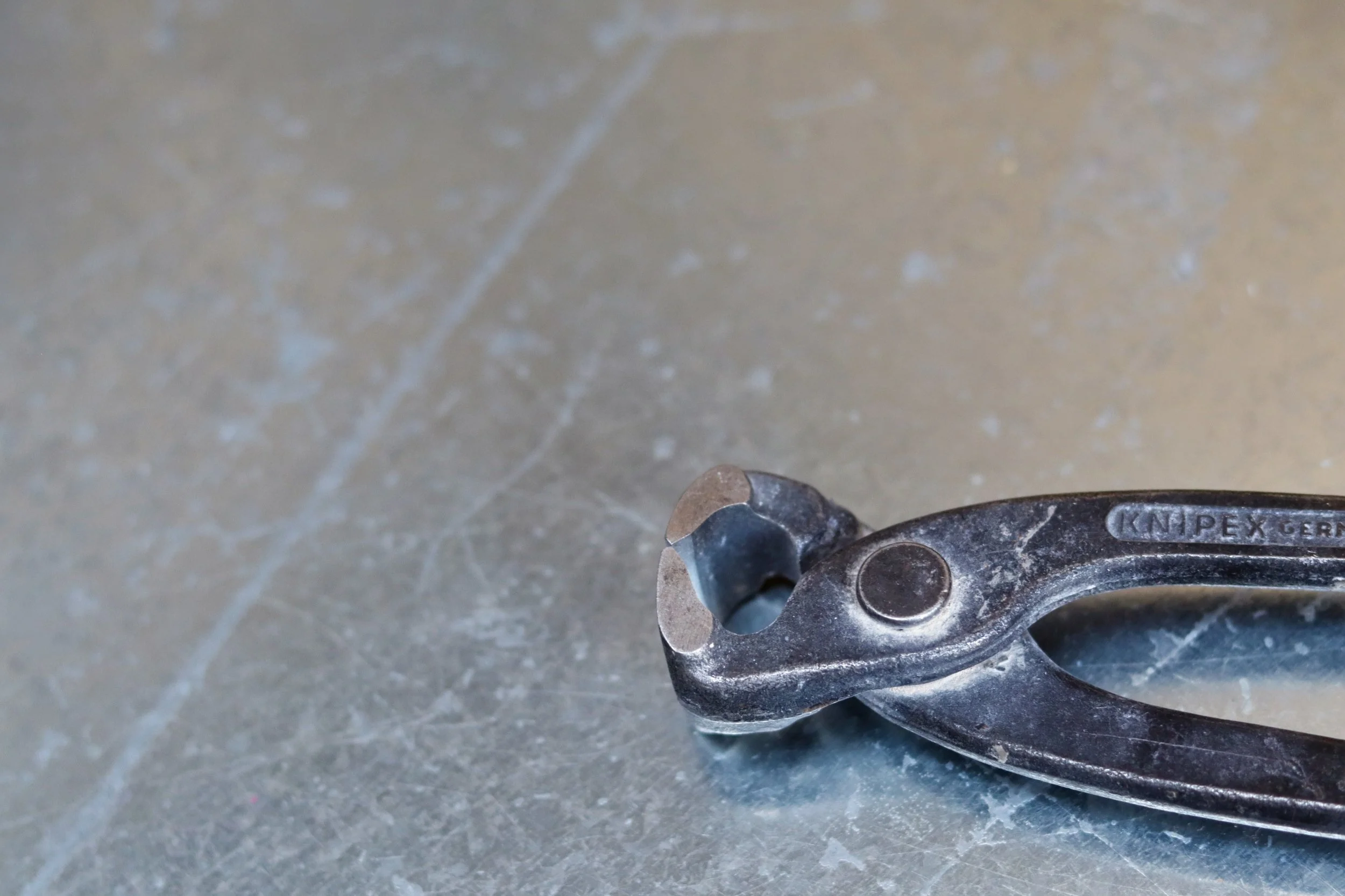
Teeth Detail
I’m comforted by the notion of only using hand-tools for mosaics. Power-cut, no problem. Working remotely, big deal. You need to travel, fine – it’s all in this little bag. I suppose this, in of itself is a way of keeping the ancient craft alive. We owe it to the past and to the future.
Good hand-tools allow us, whether we know it or not, to quietly notice things. Every cut, twist and squeeze is remembered in the thoroughfares of your arm. Each ligament and muscle echoing every single tiny movement. After years or even decades, something magical happens. Somewhere between the tile, the steel and your hand, all completely connected, you submit. You stop thinking and everything flows. Exactly the way it should.
